Services / Detail E
Mobile robots
AGVs and AMRs that move totes, carts and pallets between stations, so your people stop pushing carts.
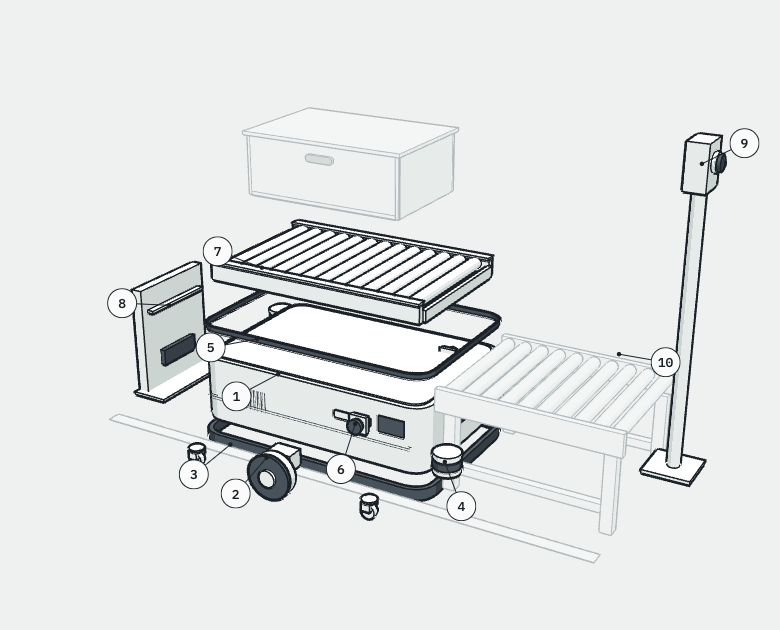
Parts listClick a part for details
What it does
Line-side delivery
Brings parts and packaging to the line before it runs out.
End of line to shipping
Takes finished totes and pallets away as they fill.
Point-to-point and tugging
Work in progress between departments, or a train of carts behind a tugger.
The right vehicle
We pick a proven off-the-shelf robot for your loads and aisles, e.g. OTTO, MiR or Seegrid.
Connected to your plant
Call buttons, PLC handshakes, conveyors and automatic doors.
Routes your people trust
Mapping, speed zones and forklift crossings, set up with your team.
A typical first job
- Problem
- People spend their shifts pushing carts between the same two places.
- We install
- 1–3 cart robots or one tugger, a charger, call buttons or a PLC handshake, on 1–3 routes.
- Timeline
- 2–4 months
- Typical range
- Scoped after a site survey
- Best fit
- Dry floors, decent Wi-Fi and marked forklift crossings.
- Measured by
- Moves per shift and hours handed back. Our integration work is typically $25k–80k (estimate), vehicles extra.
What you get
Site survey
Floors, aisles, slopes and Wi-Fi checked before anything is bought.
Map and traffic rules
Routes, zones and speed limits, handed over in your name.
Risk assessment
To the mobile-robot safety standards (R15.08, ISO 3691-4).
Plant connections
Call buttons, PLC signals and doors, documented.
Operator training
Your team learns to send, recover and re-route the robots.
Hypercare, then support
30–90 days of close support after go-live, then remote access you control.
Questions plants ask
Why not buy straight from the robot maker?
For a small fleet you'll usually buy through a partner anyway. We do the plant-side work the maker won't: PLC and door signals, carts, the risk assessment and ongoing support.
Will it work alongside our forklifts?
Usually, if lanes and crossings are separated, marked and speed-zoned. Heavy, unstructured forklift traffic is the most common reason a first deployment struggles.
What does payback really look like?
Makers claim under a year; treat that as a claim. It pays back when it takes over a person's moves across two or more shifts. A one-shift, low-volume route may never pay back, and we'll tell you.